|
Play the above movie for a virtual tour of Cordogan's Pianoland! Click on the bottom-right to view it full-screen. Buying a Piano? Please click here for links to our piano inventories: Please
call 630.584.5000
for current, best pricing and availability in your area.
Selling A Piano? Renting
A Piano?
Servicing a Piano? Exclusively from Cordogan's *** Downloadable Player Piano Song Library
Customer Software Upgrades
|
Frequently Asked Questions The piano is capable of being one of the most important investments a family can make. It can be a gateway to the arts, a vehicle for educational and mental discipline, the epicenter for family unity, a canvas for creativity and fuel for the soul. Cordogan's goal with every customer -- whether you're purchasing online or at our piano superstore-- is to make each purchasing experience a pleasant one. The following list of FAQs could be subtitled, "If I had a nickel for every time I have been asked these questions..." Seriously though, these questions are age-old in the piano business and timeless in their validity. We hope these will help in your search for a piano. Not all may be applicable for every reader, but all of our answers are brutally honest. So if you're in need of some answers, the buck starts here!
|
||||||||||||||
|
|||||||||||||||
|
|
|||||||||||||||
| Click on "How Much Are Pianos?" to find out!
|
|||||||||||||||
|
When
considering purchasing a used piano, take these checklists to the dealer, asking them
to "sign off" on the various restoration steps that the dealer likely
will claim has been performed. If these steps have really been
performed, they should have no problem doing this.
|
|||||||||||||||
|
No accurate assessment, nor even a "range" could be achieved by an on-line or telephone conversation. In fact, the odds of good advice coming from anyone who would be willing to partake in such a discussion would be a crapshoot at best. If you are in Chicagoland, we can give free advice by directing you to a technician we know in your area -- just drop us a line for more information.
|
|||||||||||||||
|
|
|||||||||||||||
|
Consoles tend to be between 40" and 44" tall; studios are usually 45" to 47" tall, while uprights are generally 48" or more. All are classified as vertical pianos, which distinguishes them from the horizontally-designed grand pianos. Why does height matter? Generally speaking, the taller the piano, the longer the strings are, the bigger the soundboard is and the better the action is. These features help the taller piano to perform and sound better than the shorter one - providing all other factors are equal (brand, vintage, condition, etc...). For the beginning student however, a spinet piano can serve as an excellent "stepping stone" instrument providing it has been properly restored.
|
|||||||||||||||
|
In most instances, the so-called "sale price" you're being offered isn't indicative of the "savings" you're being led to believe exists. Not all products in the piano industry even HAVE an MSRP (Manufacturer's Suggested Retail Price). If the manufacturer doesn't publish an MSRP, then they're leaving it up to the dealer to assign one. Convenient for the dealer (who will undoubtedly be veeeery generous) -- bad for you since it blurs the issue of value! Fortunately, there's a book in the piano industry called the Ancott book. It's not a consumer publication, but it's a book/service to which dealers can subscribe which takes ALL piano manufacturers and uses the same formula to establish a "retail" price for every model and every finish. It comes out every year, so the information stays pretty current. It places ALL brands on the same level playing field because the Ancott retails are established using the same formula for every piano in the industry. In fact, it's a better way to compare values of various brands to each other than using MSRPs, since piano manufacturers use varying formulas to assign their own retail prices. Another use for the Ancott book is to assign a fair retail price (the "Ancott" retail) to pianos which don't have an MSRP from the manufacturer. The presence of this book curbs the ability for a retailer to get away with claiming a preposterous, self-imposed "retail" in order to project a hugely discounted "sale" price. So when you see a "list"..."retail"..."was"..."MSRP"..."reg" price from which a sale price is being offered, it doesn't mean that anyone on Earth ever actually PAID that original price. Countless industries, especially those featuring consumer products have retail pricing guidelines that are respected by its dealers. The piano industry does too, but the dealers who choose to impose their own inflated retails for deceptive financial gain should be avoided at all costs. Personally, our company and store, (Cordogan's Pianoland have always made a practice of using manufacturer suggested list prices (MSRP's) on all new products whenever they are available. We use the Ancott book's prices for acoustic pianos which do NOT have an MSRP. Dealers should not legally have carte blanche to claim whatever "retails" they want with no repercussions of any kind. In fact, in
2003, Cordogan's, along with four other piano retailers, helped
consumers, like you, avoid such fraud by bringing a lawsuit against a
Chicagoland piano retailer. In this case, Biasco Piano Company was sued
for committing consumer fraud in the form of grossly inflating prices
in their advertisements and for committing eleven other deceptive
advertising practices. A DuPage County judge issued an injunction
against Biasco Piano Company prohibiting it from engaging in such
activities. Thereafter, Biasco Piano Company sought protection under
the United States Bankruptcy Code, but it has yet to return consumer
deposits estimated at over $300,000 for the purchase of pianos and
related equipment which Biasco Piano Company has never delivered. This
court ruling has had a very positive and far reaching impact on the
business practices of piano dealers across the country. We are very
proud to have been part of "The Chicago Five" (a term
dubbed by a news group) who participated in this important litigation
which has resulted in a ruling that should serve as a strong precedent
to protect you from becoming a victim of false advertising and to make
your overall piano purchasing experience a far more truthful and
enjoyable process.
|
|||||||||||||||
A. This section deals with how to choose a dealer for your used piano needs. We encourage you to find a dealer with an in-house restoration facility -- one that you can actually see, by the way -- not a mythical one the dealer CLAIMS to have, but is nowhere in sight. As a used piano shopper, this information should be very useful to you! Almost every piano dealer takes trade-ins. Some trade-ins are bound to be basket cases, some will be diamonds in the rough, most are somewhere in between. In any case, we assure you of this: No trade-in is ever ready to move right on to the showroom floor without serious work. To say it another way, every single trade in can be vastly improved by having a technician run through our checklist -- a list based upon Piano Technicians Guild standards. Performing all the steps in this list can take days. This work is referred to as "restoration work". Used pianos that are even just a few years old are not exempt from needing restoration work. Such work involves four separate areas, often performed by different craftsmen. So how do dealers tackle refurbishing and reselling their trade-ins? That depends on which showroom you have just visited. Dealerships who don't have an in-house restoration facility usually struggle to compete with those who do. Without an in-house shop, dealers are left with four choices for restoration work: 1) don't do it and sell the instrument as is, 2) don't do it and claim it was performed (you'd be surprised how often this actually occurs), 3)
allow independent contractors (as opposed to full-time technicians) to
enter their showroom and perform "restorations" without adequate tools
such as table saws, drill presses, hoists, heat guns, a spray booth
etc., making restorations -- let alone a complete rebuild -- a
near-impossibility, 4) send
the piano to an outside shop, negotiate who's responsible for any
promised warranties and be burdened with several hundred dollars spent
in moving the piano back and forth for servicing. Please feel free to contact us if you have any questions!
|
|||||||||||||||
|
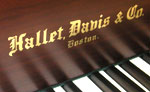
A way to quickly gain market share is to take a well-known (but now defunct) piano name and apply the familiar name to a new piano. Take Chickering, Wurlitzer, Knabe, Sohmer, Weber or Kohler & Campbell for instance. These are well known American brands that went out of business decades ago. But the names live on today on account of creative marketing minds at piano factories who recognize the value in a name brand over, say, the name of the Chinese, Indonesian or Korean factory from which the piano now comes! Cordogan's carries a brand that meet this description (Hallet, Davis & Co. - commonly misspelled as "Hallett & Davis"). There's nothing wrong with this practice so long as the dealer or person selling the piano isn't misrepresenting the piano as something that it isn't. The natural instinct is for people to take things at face value -- meaning if you see a name on a piano that says "Baldwin" following by "Cincinnati, Ohio" in smaller print, don't assume the piano was made in Cincinnati. Ask questions! :) The other type of brand name mixology occurring in the market place these days is with Steinway pianos. Steinway learned a long time ago that dealers who carried Steinway often sold mid-priced and lower-priced pianos from other brands to customers who came in to see Steinway pianos. When these customers found out how expensive real Steinway pianos were, they walked out with a piano from another manufacturer on Steinway's coattails and Steinway didn't see one dollar from the sale even though it was Steinway's marketing dollars that generated the person coming in the door. In an effort to grab a piece of that mid-priced and low-priced market, Steinway did two things: 1) they went to popular manufacturers in the mid and low-priced markets (Kawai and Pearl River respectively) and solicited them to build a line of pianos for Steinway that would be sold only through Steinway dealers and 2) they slowly but surely evolved most of their dealerships in the U.S. to only carry Steinway products. Steinway of Chicago is now actually owned by Steinway. This keeps your money in the Steinway family if you buy a piano from a Steinway dealer. This is all fine so long as you know what you're actually buying, but we see too many people buying a Boston piano (which is made by Kawai in Japan) or an Essex piano (which is made by Pearl River in China) thinking that they somehow bought a piano made by Steinway. Boston pianos and Essex pianos carry a huge pricing premium that is much higher than the comparable Kawai or Pearl River, even though conventional wisdom, internet reputation and most importantly Larry Fine's Piano Book rates them the same. So basically by purchasing a Boston or an Essex piano, you're paying a lot of extra money for a piano which cannot be competitively shopped for price, yet not receiving any musical value for paying that extra premium. If your ultimate goal is to own an *actual* Steinway piano, you may be tempted by Steinway's offer to accept a Boston or Essex for full purchase price toward a Steinway, but Steinway is in the business of selling Steinway grand pianos and since they're obviously not going to resell your Boston or an Essex trade-in for the full amount they're accepting in trade, it stands to reason that there's also room for them to accept your Yamaha, Kawai or other brand at a price that is acceptable to you. Some Steinway dealers across the country also sell a private label brand called Cristofori pianos (commonly misspelled as "Christofori" piano). The Cristofori piano brand is actually owned by a dealer who sells Steinway in several markets across the U.S. It's simply a Chinese piano for which comparison prices cannot be obtained because it's only carried by these dealers. For years it was sold here in Chicago and we were surprised to hear some consumers indicate that it was their understanding Steinway "makes" the Christofori or that Steinway has ANYTHING to do with Cristofori. Be assured, Steinway only makes STEINWAY pianos. All of the other pianos sold by Steinway dealers are manufactured by other companies. Boston is made by Kawai (Japan or Indonesia), Essex is made by Pearl River (China) and the Cristofori piano is ALSO made by Pearl River (China), who incidentally also makes many other brands. Manufacturer brochures don't make your shopping efforts any easier either when it comes to origin of manufacture. You won't see "Made in China" emblazoned anywhere on a brochure. Rather you will read all about the rich company history, the award-winning designs and family roots of these brands which in reality have absolutely nothing to do with the design or quality level of the piano you're considering. All of this can certainly be confusing to the buyer who wants to feel like they're buying a name brand product without paying the name brand price, but you really do get what you pay for -- and there are higher-rated pianos for the money than the above mentioned brands. The Piano Book by Larry Fine does a good job of recommending brands and staying fairly current with who's building who. Or if you're in our area you can come see us, we'll tell it to you straight! Cordogan's carries several top-rated brands. See our “NEW PIANO INVENTORY” for a listing. a listing.
|
|||||||||||||||
|
©2017
Chicagopianos.com/Cordogans All Rights Reserved. |
|||||||||||||||